

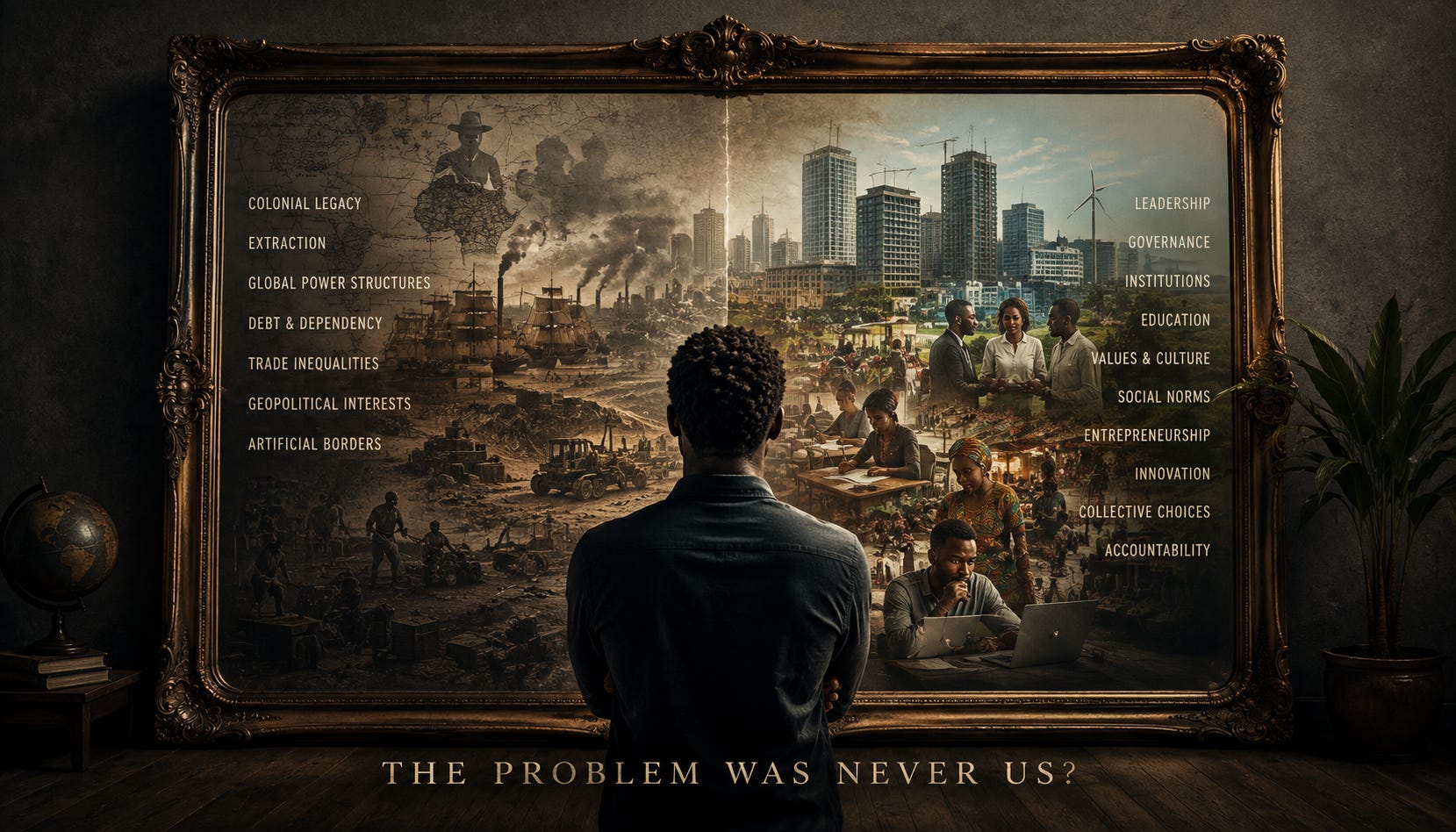
Scrolling through social media over the weekend, I came across a post that caught my attention, both for its language and its subject. “The problem was never us,” the post declared.
As I read on, it became a critical commentary on the problems facing Africa and where blame resides: bad leadership, corruption, and tribalism—failures often attributed to Africans themselves—were not, it argued, the real culprits. Rather, the blame lay elsewhere: the systems through which Africa’s leaders are “installed and removed.”
I subscribe to the perspective that our problems aren’t our leaders alone; that we, in fact, place far too much emphasis on the misunderstood concept of leadership, at the expense of more significant considerations, including our own role. Ultimately, our leaders are reflections of our society.
And that’s exactly where the social media post lost me.
It reminded me of the debate that has raged on within our community for ages, capturing the imagination of ordinary citizens, experts, and keen observers alike: what precisely is at the root of Africa’s social, economic, and political challenges, and why can’t we seem to ever achieve lasting prosperity that touches the lives of those who matter the most?
As the post and the comments it generated suggests, we are no where closer to resolving the vexing problem of Africa’s advancement for the simple fact that we can’t seem to even agree on its root cause.
Those who follow the scientific method understand that solving a problem begins with recognizing and acknowledging that there is one. The problem must then be clearly defined and its source diagnosed before one can move on to formulating a hypothesis.
We are doing a lot of the latter as a community, not because our hearts are in the wrong place, but because we’ve been conditioned to find fault where it’s most convenient and ignore it where it’s most uncomfortable.
So perhaps what we need is a bit of recalibration.
Instead of forming a hypothesis and testing solutions in the form of accusations about who or what is at fault, perhaps we can begin where proven problem-solving methods tell us we should: by determining how, or through what lens, to examine Africa’s challenges, given our collective admission that we indeed have a problem.
What follows, then, is an attempt to recalibrate how we look at Africa’s challenges: what we believe stands in the way, how we define and connect the forces at play, and ultimately, which lens best helps us understand the problem.
Impediments
There is broad agreement on what people consider the contributing factors, reflected in how our challenges are commonly categorized. They are generally understood as either external or internal in origin, much as the late Ghanaian scholar George Ayittey concluded in Africa in Chaos.
Externalists, he explained, identify the root impediments as “colonial legacies, Western Imperialism, the slave trade, an unjust international economic system, and [exploitative] multinational corporations, among others” — the perspective of the social media post mentioned earlier.
Internalists place the blame on “incompetent leadership and the establishment of defective political and economic systems in postcolonial Africa,” as well as the continent’s geography and environment.
The two sides hold firmly to the primacy of their respective positions, but perhaps what is misunderstood, even among experts, is the extent to which both factors can simultaneously and profoundly shape conditions in Africa.
Framework
My observation above is rooted in social learning, a theory based on traditional behaviorism, which explains human behavior through simple stimulus-response (SR) associations.
As Professor Malcolm Watson (2002) explained in Theories of Human Behavior, traditional behaviorism holds that people learn and respond based on stimuli from their environment.
Canadian-American psychologist Albert Bandura (1974) added two important elements to this traditionalist approach.
First, Bandura emphasized that people learn expected contingency from observations. We act or behave, in response to a stimulus, based on what we believe from having experienced a stimulus.
Second, Bandura emphasized that humans learn primarily through observation and imitation of others.
This “vicarious reinforcement” suggests that “we might expect a contingency [from a stimulus] but we don’t have to experience it firsthand. We can observe contingency from others; therefore, this [process] is social” (Watson, 2002).
If human behavior is determined by “the bidirectional influence process” of environmental sources of control and personal control, Bandura concluded, then “Human accomplishments result from reciprocal interaction of external circumstances with a host of personal determinants,” including cognition and self-initiative or agency (p. 867).
This formulation of the determinants of human behavior grounds the relationship between choice (personal control), culture (environmental sources of control), and socio-economic development (human accomplishments) and, potentially, its influence on conditions in Africa.
Bandura’s idea of vicarious reinforcement highlights the importance of this connection.
He said it helps explain how people can learn new behaviors or change existing ones simply by observing what happens to others, even when they are not directly rewarded or punished themselves. People don’t just respond to their environment; they also think, observe, and make choices based on what they see.
The connection between choice, culture, and socio-economic transformation or development in Africa might be worth exploring, but first we need to define choice and culture and ask whether they offer a useful way to understand Africa.
Choice
Human choice is variously described as freedom, agency, or action, each term carrying its own contextual nuance. Together, however, they point to one of humanity’s oldest debates: free will versus determinism.
We need not resolve that debate here.
Our concern is more practical: humans possess the capacity to choose, and through those choices we produce change. As Gary Chapman (1992) put it, “We are creatures of choice,” which necessarily means that “we have the capacity to make poor choices” (p. 131).
More on that in a moment.
Choice, in its simplest sense, is the act of deciding among multiple possibilities. Yet its significance extends beyond the outcomes decisions produce. Scanlon (1986) argued that choice encompasses both the action of choosing and the circumstances in which that action determines what happens.
Choice therefore has value not merely because it produces outcomes, but because choosing itself is significant to human beings. Leotti et al. (2010) reinforce this point, demonstrating through neurological, clinical, and behavioral evidence that the presence or absence of choice profoundly affects emotion, cognition, physiology, and our sense of control.
To choose is to express a preference, assert the self, and reinforce perceptions of control and self-efficacy. Choice is therefore not simply something humans do; it is part of how we experience ourselves as human.
Hannah Arendt’s (1958) conception of action reaches a similar conclusion from another direction. For Arendt, speech and action are fundamental expressions of our humanity and our existence among others.
Our capacity to choose, act, and give voice to our purposes does more than shape individual lives; it sets in motion the circumstances that determine the kind and quality of life we collectively experience.
This makes choice particularly important to the African experience, and it takes us back to what Gary Chapman said about our capacity to make poor choices.
More than six decades after political independence, Africans possess, at least in principle, the agency to determine the course of our societies. The question, then, is not simply whether African leaders have made poor choices, but whether our collective choices have helped produce and sustain the conditions in which those choices are made.
The literature suggests that leadership failure alone does not adequately explain Africa’s challenges.
Poor governance is enabled, in part, by the choices citizens make in selecting leaders and by what follows those selections: the abandonment of the social process of leadership itself, which is leadership driven by community engagement.
Once leaders assume office, they are too often left largely to their own devices, with weak accountability for the choices they make. The social obligations of leadership—engaging others, negotiating, compromising, exercising ethical judgment, and sacrificing for the greater good—are consequently weakened.
Cappelen et al. (2020) further illuminate the relationship between choice, agency, and inequality. Their work suggests that greater freedom of choice can reduce demands for redistribution, while restrictions on choice can increase them. Applied to African societies, this helps reveal a troubling cycle.
Citizens choose leaders; those leaders consolidate power through patronage and other mechanisms that restrict meaningful choice; restricted freedom generates greater demands for redistribution; those demands go unfulfilled; inequality and social tension deepen; and citizens either disengage from national life or place an increasingly high premium on securing political power.
In this way, poor choices become more than isolated decisions. They become embedded in institutions, relationships, expectations, and culture. Our choices can therefore restrict the very freedoms we seek, while the consequences of those restrictions generate new choices that perpetuate the cycle.
The challenge of African social transformation is thus not only a problem of inadequate leadership or defective institutions. It is also a problem of agency: how we exercise our capacity to choose, whom we choose, what we tolerate after choosing, and whether we accept responsibility for the consequences.
The vicious cycle of poor choices therefore reaches into the very fabric of our societies. Yet it is often underestimated or dismissed when we turn our attention to socioeconomic and political matters.
If choice is fundamental to human agency, then understanding how we collectively exercise it is fundamental to understanding both the problems we face and our capacity to change them.
Culture
There is considerable debate in the literature about culture—what it is, how it is measured, and whether it has a meaningful role in social transformation.
A classic definition describes culture as the behaviors and material objects associated with human life, including language, ideas, beliefs, customs, institutions, tools, techniques, art, rituals, and ceremonies (Britannica, 2023).
For purposes of this discussion, however, culture is more narrowly understood as a way of life centered on the thinking and behavior of a people. While material artifacts are significant, it is symbolic culture—the ideas, values, beliefs, and symbols of a people—that is most relevant to human development.
Whether culture belongs in the discussion of socioeconomic transformation remains contested.
Acemoglu and Robinson (2013), for example, rejected culture as a primary explanation for persistent inequality, arguing that factors such as trust and cooperation are largely outcomes of institutions rather than independent causes.
Other scholars similarly emphasize politics, institutions, or leadership, while Kuada (2010) recognized culture as both a source of distinctive African leadership and a constraint on its development.
Dieckmann (1996), by contrast, argued that economic performance is culturally bounded because people absorb the values prevailing in their families, schools, and societies.
Ajah (2014) made the relationship between culture and development more explicit through his “culture-agency” model. His logic is that development results from human actions; human actions result from choices; choices reflect systems of valuation; and valuation systems are aspects of culture.
Social transformation therefore requires placing members of a society at the center of their own transformational process.
Ajah further connected this transformation (development) to truth-telling, drawing on an Igbo conception of truth and Ricoeur’s (1986) idea of narrative identity to question whether Nigerians can meaningfully confront their national condition without first being truthful about who they are and how they have come to live together.
His argument is relevant beyond Nigeria.
Whatever the shortcomings of Africa’s inherited borders or development models, Africans remain the agents making choices within them, and those choices are embedded in values and expressed through ways of life—that is, through culture.
Osabu-Kle (2000) approached the issue through Africa’s political traditions, arguing that development would benefit from incorporating elements of indigenous African political culture into contemporary governance.
He attributed part of Africa’s difficulty in transforming to the adoption of foreign political practices, particularly Western-style partisan democracy, and proposed instead a more consensual political culture that balances centralization and decentralization to check abuses of power—a perspective again shared by the social media post mentioned in the beginning.
Yet his argument ultimately remains focused on the institutions through which Africans make decisions, reinforcing a question raised by the broader literature: whether institutions alone can explain why societies create, sustain, or fail to reform them.
Matthew Arnold (1869) offers a different conception of culture—as a transformative force within society itself. Writing amid England’s social upheaval during the Industrial Revolution, Arnold observed increasing materialism, self-interest, and social alienation.
He proposed culture as an antidote, defining it as the pursuit of perfection through the development of mind and spirit, combining the desire to see things as they are with the moral and social desire to do good.
His argument may seem distant from contemporary Africa, particularly given his position as a privileged citizen of a former colonial power, but the underlying proposition is broader than his historical setting: societies can be transformed by changing what their people value, how they think, and how they relate to one another.
Nigerian scholar Wole Soyinka offers a more contemporary African expression of this same idea.
In a 1999 address to the International Monetary Fund, Soyinka described his experience of Palermo, Sicily, which he had first encountered as a city marked by alienation, corruption, and the pervasive influence of the Mafia. On returning years later, he found a transformed city whose people were engaged, connected, and invested in their collective life.
Soyinka called this transformation “Renewal,” particularly cultural renewal. What mattered was not culture as spectacle, but a “culture of participation” and “social mobilization,” a transformation of defeatism and the cultivation of creativity, democracy, and civic responsibility.
Soyinka’s Palermo illustrates culture as a lived practice. Its people were no longer merely subjects of their circumstances; they were participants in their own social renewal, directing their energies toward becoming something rather than merely having something.
In this, Soyinka echoed Arnold’s earlier distinction between inward human development and an excessive preoccupation with external, material progress.
For Soyinka, social transformation therefore cannot be adequately measured through economic indicators alone. It must also be understood through the capacity of human beings to think critically, express themselves creatively, pursue individual purposes, accept responsibility for others, and resist the alienation and defeatism that inhibit collective progress.
Culture, understood as a continuing process of creative participation, becomes not peripheral to social transformation or development but integral to it.
Arnold and Soyinka, despite their differences in era, ethnicity, nationality, and circumstance, arrived at a similar insight: societies are transformed not simply by what they build or possess, but by what their people have learned to value and how those values are expressed in collective life.
Alignment
A salient truth about humanity is thus choice (human agency) and culture (human environment) converge in our lives to make change possible. The convergence sets the table for the social process of leadership—an orientation toward collective engagement for community advancement.
This orientation is predicated on individuals leveraging our ethics, what Barker (1997) defined as a spiritual definition of life, in the process of engaging with others.
When the goal of those engagements is human and social development, leadership becomes less about occupying a position of authority or possessing traits capable of turning around a struggling enterprise and more about navigating the complex social and political processes through which communities advance.
Barker explained that the social process of leadership emerges through training in communication, coalition building, and compromise; through the development of individual emotional and intellectual capabilities; and through education in the “social patterns and moral orders” that integrate knowledge, ideals, insights, experiences, and behavior, contributing to the “process of integrating individual ethics into community mores” (p. 360).
This development raises awareness and responsibility in the individual through a focus on choice (decision-making) and the consolidation of an enabling culture—one that Arnold and Soyinka described as aligning thinking and behavior toward personal betterment and community advancement.
Examined through this lens, the view that “the problem was never us” is, to put it as politely as I can, off the mark.
External forces—history, institutions, colonial legacies, Western influences, and the broader political, economic, and social conditions within which African societies have had to operate—matter. But so too do the internal forces of choice, agency, and culture: the values, beliefs, and ways of life through which Africans have understood and exercised that agency.
At the same time, however, the distinction between internal and external forces is not absolute. Culture itself is shaped by external forces, including the enduring influences of slavery, colonialism, Western institutions and ideas, and the postcolonial world. African societies have therefore had to navigate an environment in which external conditions shape internal values and choices, even as those values and choices shape how societies respond to their circumstances.
The question is therefore not simply what has happened to Africa, but how we have responded to it, what we have chosen, and what our culture has enabled us to become. In essence, the point is not to choose between external explanation and internal agency, but to understand how the two interact.
So, the lens we use to examine Africa must account for both the external impediments that have shaped our circumstances and the internal impediments reflected in our choices and culture. Only then can we move beyond the search for someone or something to blame and toward an honest diagnosis of the problem, one that recognizes our agency and creates the conditions for the social process of leadership to emerge.
In this sense, recalibration is not an abandonment of history or a dismissal of its consequences; it is a decision to examine the whole problem so that we might finally begin solving it.
References
Acemoglu, D., and Robinson, J.A. (2013). Why nations fail: The origins of power, prosperity, and poverty (Pbk. ed.). Crown Business.
Ajah, A. (2014). On Truthful narrative-identity and a development model for Nigeria. Open Journal of Philosophy, 4, 531-540. http://dx.doi.org/10.4236/ojpp.2014.44055.
Ake, C. (1996). Democracy and development in Africa. Brookings Institution.
Arendt, H. (1958). The human condition. The University of Chicago Press.
Arnold, M. (1869). Culture and anarchy: An essay in political and social criticism. Macmillan.
Ayittey, G. (1998). Africa in chaos. St. Martin's Press.
Bandura, A. (1977). Social learning theory. Prentice Hall.
Bandura, A. (1974). Behavior theory and the models of man. The American Psychologist, 29(12), 859–869. https://doi.org/10.1037/h0037514.
Barker, R. A. (1997). How can we train leaders if we do not know what leadership is? Human Relations, 50(4), 343–362. https://doi.org/10.1177/001872679705000402.
Bonsu, O. K. (2002). Leadership: The missing variable in the economic development of sub-Saharan Africa. ProQuest Dissertations Publishing.
Cappelen, A., Fest, S., Sørensen, E. Ø., and Tungodden, B. (2022). Choice and Personal Responsibility: What Is a Morally Relevant Choice? The Review of Economics and Statistics, 104(5), 1110–1119. https://doi.org/10.1162/rest_a_01010.
Chapman, G. (1992). The 5 love languages: The secret to love that lasts. Northfield Publishing.
Dieckmann, O. (1996). Cultural determinants of economic growth: Theory and evidence. Journal of Cultural Economics, 20(4), 297-320. http://dx.doi.org.proxymu.wrlc.org/10.1007/s10824-005-7320-0.
Ekeh, P. (1986). Development theory and the African predicament. Africa Development / Afrique Et Développement, 11(4), 1-40. http://www.jstor.org/stable/24486618.
Gemmill, G., & Oakley, J. (1992). Leadership: An alienating social myth? Human Relations (New York), 45(2), 113–129. https://doi.org/10.1177/001872679204500201.
Juma, T.O., and Oluoch, K.K. (2013). System failure causes of conflict in Africa as a social transformation. International Affairs and Global Strategy. Vol.17, 2013
Kuada, J. (2010). Culture and leadership in Africa: a conceptual model and research agenda. African Journal of Economic and Management Studies, 1(1), 9-24. https://doi.org/10.1108/20400701011028130.
Leotti, L. A., Iyengar, S. S., and Ochsner, K. N. (2010). Born to choose: the origins and value of the need for control. Trends in cognitive sciences, 14(10), 457–463. https://doi.org/10.1016/j.tics.2010.08.001
Lin, J.Y. (2014). The Quest for prosperity: How developing economies can take off. Princeton University Press.
Njoh, A. J. (2006). Tradition, culture and development in Africa: Historical lessons for modern development planning. Ashgate Publishing.
Scanlon, Thomas M. (1986). The significance of choice. The Tanner Lectures on Human Values, 7: 149-216.
Soyinka, W. (2000). “Culture, democracy and renewal.” Trends in Organized Crime, 5(3), 110-117.
Watson, M. W. (2002). Theories of human development. Teaching Co.
Brilliant essay. Examines the decision-making from every angle.
Maybe there's some truth after all to the idea that the problem really did lie outside Africa. It connects to how the economic dimension gets underestimated, with people reaching for answers outside economics instead. It's hard to choose correctly when no path leads to success.
The Western world is now living something similar. Factory collapses, layoffs, and the resulting decline of entire regions have become an ordinary part of reality. In that situation there's no right decision, because it's a loss in competition — a loss against 200 states and millions of firms worldwide. No leader and no genius, no culture, can reverse that kind of defeat. A new winner has to emerge, and decline simply moves on to the next location.
Africa has lost this competition more often. But not always. Worth looking at the African startups and communities that found their footing locally and are prospering — and studying how they managed to outcompete the field.
Then there's another path Africa is uniquely suited for: bring money into regions and keep it there. A way exists. That measure should start reviving local economies across most regions, step by step.