
Remember Strom Thurmond?

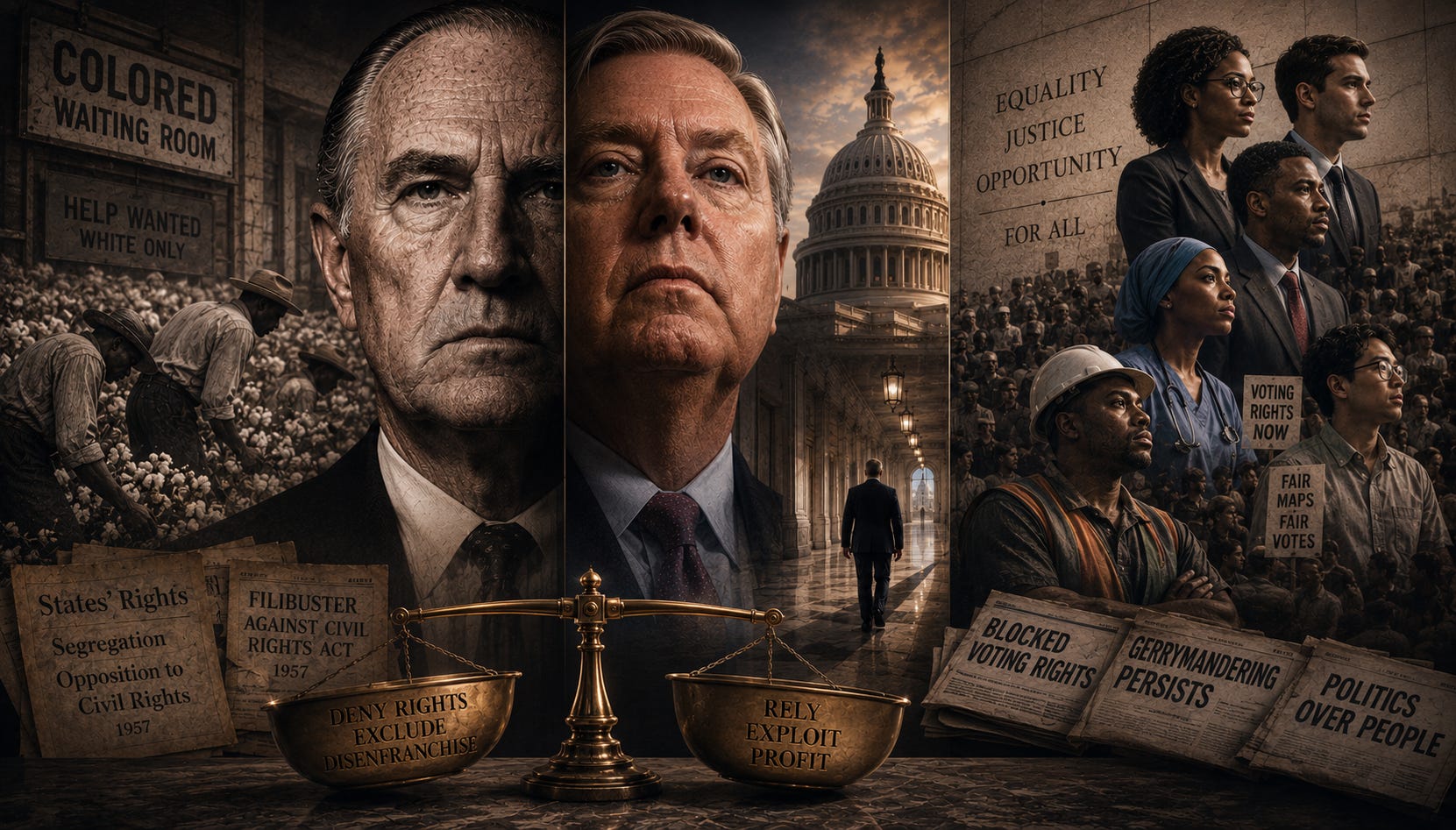
Remember Strom Thurmond, the Senator from South Carolina who was a staunch segregationist? His name resurfaced this past week on account of all the attention South Carolina is getting because of the sudden death of another one of its Senators, Lindsey Graham.
More on him in a moment.
Thurmond’s name struck a nerve for a lot of reasons, none bigger than what I did not know about the man until reading an article that illuminated the contradiction of South Carolina. The state, history shows, is notorious for being the first to secede from the United States in 1860 out of support for slavery and the confederacy.
And while Confederate symbols remain part of its landscape, South Carolina today affirms a commitment to equality and inclusion, reflecting a conscious effort to distinguish the modern state from its slavery and segregationist past.
Among those efforts is the state's decision in 2021 to add the name of Essie Mae Washington-Williams to the list of Thurmond's children on his statue outside the South Carolina State House. The history behind it all is telling.
In 1925, when Thurmond was 22 years old, he fathered a daughter with Carrie Butler, a 16-year-old African American domestic worker employed in the Thurmond family home. Their relationship occurred within a society defined by profound racial inequality and unequal power, and Thurmond kept his paternity private throughout his political career.
Washington-Williams publicly identified Thurmond as her father only after his death in 2003, prompting South Carolina to acknowledge her alongside his other children on the monument two decades later.
Less well known is that Thurmond maintained a relationship with his daughter throughout her life. He helped pay for her education, provided financial support over the years, and remained in contact with her, while both maintained an understanding that his paternity would remain private during his lifetime.
The arrangement stood in stark contrast to Thurmond's public career. As he quietly acknowledged his African American daughter in private, he became one of the nation's most prominent defenders of racial segregation, campaigning for the presidency in 1948 on a segregationist platform and later using his influence in the U.S. Senate to oppose civil rights legislation.
As I read this story and delved deeper into the history, I found myself troubled not only by the contradictions of Thurmond's era but also by the striking parallels between that period and our own political moment.
One connection is the recurring tension between public narratives about social boundaries and the realities of American society. The contradiction in Thurmond’s case was immensely personally. He publicly defended and voted for a system of racial segregation while privately fathering an African American, revealing that the ideology of rigid racial separation he devoted his political life to was at odds with his own lived reality and those of his society.
In the context of our own political moment, the connection is not about a private personal contradiction that mirrors Thurmond's but a tension that is structural in nature. Our leaders today advocate for policies that would substantially reduce immigration while the U.S. economy and society remain deeply interconnected with immigrant labor and immigrant communities.
It is a pattern that has appeared repeatedly in U.S. history, from slaveholding states depending economically on enslaved African labor while denying Africans equal humanity and rights, to the Jim Crow South relying on African workers while maintaining legal segregation, to various industries relying on immigrant labor while periods of political backlash attempt to limit immigration or restrict immigrants' rights.
The connection, from this perspective, is not just hypocrisy but a desire to benefit from a group's labor while limiting its social, political, and demographic influence, which raises yet another parallel between then and now: the debate over national identity.
Thurmond and politicians of his era defended the idea of a racial hierarchy rooted in white supremacy. Today, our restrictionist immigration policies similarly emphasize preserving a particular conception of American identity that is culturally and demographically rooted in the America ‘s European heritage — even if the architects calculatingly frame their efforts in language designed to train focus on economics, security, and the rule of law.
And so, while Thurmond and his era are not identical to the politicians and politics of today, both reveal a persistent American contradiction: a nation that depends on the labor, participation, and contributions of marginalized communities while repeatedly contesting their place, rights, and full membership in the national community.
To be sure, the greatest irony of Thurmond’s life is perhaps that a man who spent decades defending racial separation and inequality was himself connected by blood to the very community he sought to exclude from full participation in American society.
His legacy did not end with his retirement or his death. It lives on in a political culture that has often prized power over principle and expedience over consistency. Few figures illustrate that continuity more clearly than Lindsey Graham, the man who replaced him in the Senate.
Once known for criticizing conduct and rhetoric that he later defended, Graham's political evolution, now being exposed like never before in the wake of his death, reflects a tradition in South Carolina and American politics in which survival and influence frequently outweigh ideological consistency.
In that sense, Graham's transformation is not an aberration but an inheritance.
Like Thurmond before him, he demonstrated a willingness to reconcile public contradictions in pursuit of political relevance, including voting against impeaching the man he once said was a danger to the republic, then going on to become one of his staunchest enablers in the Senate.
That willingness helped normalize a style of politics in which conduct once considered disqualifying is treated as acceptable if it serves partisan ends. The consequences extend far beyond any one politician.
When elected leaders defend or enable behavior they once condemned, they lower the standards of democratic accountability and make possible policies that target immigrants, racial minorities, and other marginalized communities.
The contradiction that defined Thurmond and Graham’s careers, the gulf between America's professed ideals and the exercise of political power, has not disappeared. It has simply taken new forms. Understanding that continuity is essential to understanding the political moment the United States faces today.
I have circled back to this article repeatedly today between cases in the OR. I kept rereading the last two paragraphs because they hit at something that I have felt for a while. It is this lack of responsibility that has echoed for so long, and demonstrates that those in power speak from both sides of their mouth.
True, we may all do this at times. Human nature is contradictory. But we should be able to guard against the more sinister aspects of our temperament. ‘Should’ being the key word there.
I remember learning about Storm Thurmond in my adolescence and experiencing the anger and disgust at what some will do with power. But that emotion wasn’t foreign to me. Steeped in the tales of lynching and pogroms from around the world, I understood that many with power will only serve themselves by putting others down (both metaphorically and literally). Learning about his daughter, Essie Mae, in 2003 demonstrated to me the contradiction of responsibility in the hands of individuals like Thurmond.
At 41 years old, stories like that of Thurmond and Graham still bother me. But it also comes with the understanding that human nature is not fixed - neither collectively nor individually. Our humanity is based on a choice. Some of those choices are made for us, and yet some of those choices are one’s that we can influence. I keep hoping we’ll figure out how to tip the scales away from contradictions that pull us into more sinister directions.
Great work. You have no idea how many Black folks have gotten rich by playing along with the blatant contradictions that Strom Thurmond and so many other white men have perpetuated.